
Scholar’s Note: The First Amendment, Government Regulation, and No Kings
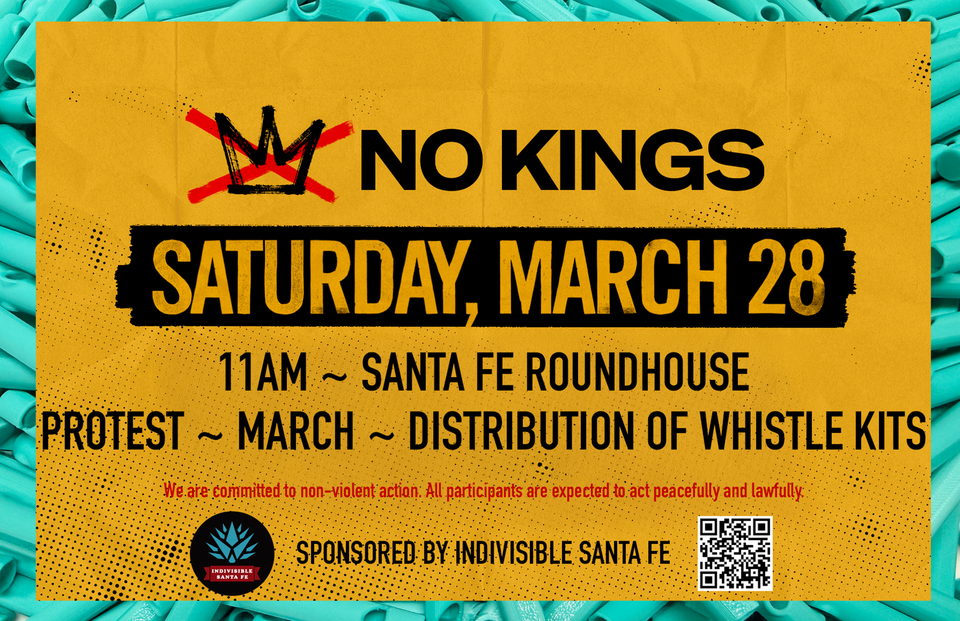
Cross-posted from here.
In New Mexico and the United States more generally, we the people are guaranteed rights to assemble and to express our views, free from government restraint. On March 28, when millions of people across the country will participate in No Kings events, they will live these rights. The medium will be a significant measure of the message: in America no government official may violate people’s civil rights, including their rights to assemble and express their views about democracy, rule of law, and life, liberty, and the pursuit of happiness.
In Santa Fe, I hope the City will make possible a closed street march. It has not for past No Kings and related events in Santa Fe, and so far it has not for this one.
In practice, both freedom of assembly and freedom of speech are subject to some regulation. A catering hall will be fined for crowding more partygoers into the facility than the fire marshal deems safe. A blackmailer speaks and the expression of his threat is a crime. So what do freedom of assembly and speech mean in practice? More specifically, how do the First Amendment and corresponding state constitutional provisions apply to rallies, marches, and vigils being held for No Kings 3?
The answer lies in well-established, decades-old legal tenets and how courts have applied them. The bottom line: governments, including municipalities and their departments, may not impose unstructured, open-ended costs for permits for political events in streets and parks; government may not charge political speakers the costs of public safety measures necessitated from either the possibility or actual presence of counter-protesters at such events. At most, governments may only charge published, comparatively low fees for permits to use streets or parks for political speech. Furthermore, governments are limited in how much advance notice, liability insurance, and other requirements they can impose on political speakers who wish to gather on streets or in parks.
In New Mexico, at least with regard to the grounds of the State Capitol, the state of New Mexico exemplifies government conforming to these principles. Those familiar with the Roundhouse know that all around it are grassy areas and plazas that together constitute one large de facto park. This attractive, expansive outdoor space is open to the public at large. Since Donald Trump’s second inauguration it has been the site of several major political demonstrations, including No Kings 1 and 2, Hands Off, and the Labor Day Rally for Collective Action.
The state of New Mexico does not charge a penny to use the Roundhouse grounds for such events. It requires event planners to submit a reservation request to the Building Superintendent’s office. This is a fairly short form that asks for some basic information. The Building Superintendent may contact the requester with questions, but at least for the requester, there is no involvement of the New Mexico state police, the law enforcement agency with responsibility for public safety at the Roundhouse and its grounds.
When it comes to the City of Santa Fe, the story is different. Almost no feature of the City of Santa Fe’s permitting scheme for political speech in streets and parks is constitutional.
The City’s published permit requirements are significant, complicated, and non-exhaustive. Unpublished permit requirements are even more onerous. These are imposed on a case-by-case basis, requiring permit seekers to make themselves available for meetings with representatives of the City and the Santa Fe Police Department. The Police Department has discretion to set any fees it chooses without giving a binding estimate, but instead billing as it sees fit after the fact. Fees are estimated in relation to the content of the speech at the event, because when the police department and the city decide that an event is “political,” they take the position that any costs the police care to impose because of concerns about counter-protesters are to be borne by the party requesting a permit. This means that when they calculate charges to the speaker they are considering the content of the speakers’s views, a quintessentially unconstitutional content-based regulatory evaluation. Additionally, the City imposes other constitutionally impermissible mandates. Speakers who wish to assemble in parks and streets for political expression are required to pay for all signage and equipment required by a third party vendor’s traffic plan, pay for the traffic plan itself, and find and pay for a hefty liability insurance policy making the City the beneficiary of any claims. If liability insurance is unavailable, the City will not issue a permit. The City offers no accommodation on these costs to speakers who cannot afford to pay the total.
A municipality can save an otherwise unconstitutional permit scheme by allowing the use of sidewalks as an alternative venue for political speech, so long as the sidewalks provide ample opportunity for meaningful communication of the political views in question.
The City of Santa Fe does authorize sidewalk marches, subject to the conditions that participants not block others from using the sidewalks, must remain mobile, and must follow traffic signals and signs. Because of the narrowness, and sometimes the absence, of sidewalks in much of downtown Santa Fe, it is questionable when and whether sidewalks there are ever ample enough to cure the constitutional defects in the City’s approach to street and park permits.
More problematically, when representatives of Indivisible Santa Fe (ISF) recently informed the City that ISF would pursue this alternative, the city suggested that ISF would be liable for any damage claims arising from such a march, particularly if marchers chose to depart from the route ISF would be publicizing. While such damage claims against ISF would very likely not succeed, the City’s stance intimates that the City itself would seek reimbursement from ISF for any litigation expenses, including damage awards, incurred by the City as a result of the City’s choices about providing for public safety. This would force ISF to either defend against such an effort or to settle, both expensive options. In practice, the City was not offering a genuinely less burdensome, sufficiently ample opportunity to No Kings speakers to make up for its constitutionally invalid approach to street and park permits.
Many cities have regulations that, as written or applied or both, offend we the people’s rights to assemble and express our views. Before No Kings 3 on March 28, the City of Santa Fe has the chance to bring itself into compliance with what the U.S. and New Mexico constitutions guarantee. The City could issue a no- or low- cost permit for closing selected streets between the Roundhouse and into downtown Santa Fe. It could, on its own initiative, plan and prepare an adequate plan for ensuring the public safety of a sidewalk march.
Whatever the City decides to do, I urge everybody who comes to Santa Fe on March 28, to exercise their rights to freedom of expression and freedom of assembly, and to say:
Appendix
Most of the basic legal tenets in support of the above analysis arise from Forsyth Cnty., Ga. v. Nationalist Movement, 505 U.S. 123 (1992). In Forsyth, the U.S. Supreme Court addressed the question: “whether the free speech guarantees of the First and Fourteenth Amendments are violated by an assembly and parade ordinance that permits a government administrator to vary the fee for assembling or parading to reflect the estimated cost of maintaining public order.” The Court answered with a decisive YES, such an approach does violate the First Amendment. The full opinion is fascinating.
Below is a list of legal principles applicable to the issue decided in Forsyth, with references to judicial authority for each. Where no authority is specifically given, Forsyth itself is the source.
- Streets and parks are the archetype of a traditional public forum.1
- A government is at its most limited in regulating public speaking, parades, or assemblies in a traditional public forum.2
- A government may impose a permit requirement for holding a march, parade, or rally but government permit scheme may not delegate overly broad licensing discretion to any government official, including representatives of the police department. 3
- To comport with the First Amendment, any permit scheme controlling the time, place, or manner of speech must not be based, explicitly or functionally, on the content of the message. Likewise, any permit scheme must be narrowly tailored to serve a significant governmental interest, and must leave open ample alternatives for communication.4
- If a permit scheme “‘involves appraisal of facts, the exercise of judgment, and the formation of an opinion,’ by the licensing authority, ‘the danger of censorship and of abridgment of our precious First Amendment freedoms is too great" to be permitted.’”5
- The decision of how much to charge for police protection or any other fees may not be left to the whim or discretion of any municipal official, including representatives of the police department.
- A municipality cannot pass along the costs of security against counter-protesters to a speaker.
- A municipality may not charge a speaker for clean up from litter after a protest, rally, or march in traditional public forums, such as sidewalks, streets, and parks.
- A municipality’s liability insurance insurance requirements, like any other regulation of speech and assembly in streets, sidewalks, or parks must be ‘(1) be “justified without reference to the content of the regulated speech;”(2) be “narrowly tailored to serve a significant governmental interest;” (3) “leave open ample alternative channels for communication of the information;” and ( 4) “not delegate overly broad licensing discretion to a government official.”’6
- Pence v. City of St. Louis, Mo., 958 F. Supp. 2d 1079, 1082–83 (E.D. Mo. 2013); Perry Educ. Ass'n v. Perry Local Educators' Ass'n, 460 U.S. 37, 45, (1983) (“In places which by long tradition or by government fiat have been devoted to assembly and debate, the rights of the state to limit expressive activity are sharply circumscribed.”); Frisby v. Schultz, 487 U.S. 474 (1988) (“[A]ll public streets are held in the public trust and are properly considered traditional public fora.”).
- Perry Educ. Ass'n v. Perry Local Educators' Ass'n, 460 U.S. 37, 45, (1983) ↩︎
- In addition to Forsyth, see Pence v. St. Louis, Mo., 958 F. Supp. 2d 1079, 1083 (E.D. Mo. 2013), making it clear that even a regulation that does not explicitly grant discretion but in practice operates to do so is impermissible; Knights of Columbus Council 2616 v. Town of Fairfield, No. 3:22-CV-1579 (D. Conn. Aug. 22, 2024), concluding that without articulated, content-neutral standards, municipal requirements for a permit fail; Naples Pride v. City of Naples, No. 2:25-CV-291-JES-DNF, 2026 WL 91486, at 2 (M.D. Fla. Jan. 13, 2026), rejecting Naples’ permitting scheme because Naples’ ordinances and supporting guidance allow the city to assess permit fees beyond those publicly promulgated, allow the city to require “require Police, Fire, custodians, parking garage attendants, solid waste barricades, etc.,” at events, with “all services provided for the event [to] be paid for by the [event organizer],” and give the city discretion to determine what of those services are necessary to “ensure the safety of participants, minimize the inconvenience to residents and reduce the liability exposure to the City.” ↩︎
- Pence v. St. Louis, Mo., 958 F. Supp. 2d 1079, 1083 (E.D. Mo. 2013). ↩︎
- Forsyth, 130. Internal citations omitted. ↩︎
- iMatter Utah v. Njord, 774 F.3d 1258, 1263 (2014) ↩︎ (Invalidating a Utah insurance requirement identical to the one required by the City of Santa Fe, and upholding only a nominal permit fee where the government presented no evidence justifying its required minimum insurance coverage of $1,000,000 per occurrence and $2,000,000 in aggregate; further holding that the government must narrowly tailor its insurance requirements to objective characteristics of an event, such as duration; and further holding that permittees may not be required to buy insurance against risks for which permittees could not be held liable, such as the unlawful conduct of others or hazards arising from public maintenance (or lack thereof) of streets. The iMatter court stated that government "cannot use its insurance requirements to indirectly impose costs on organizations that it could not impose on them directly." iMatter, 1270.)